
After the massive sell-off since October, foreign portfolio investors (FPIs) are no longer the biggest non-promoter-shareholders in top Indian companies. This has happened for the first time in over a decade. "At 25.6 per cent ownership of India's largest 75 companies, domestic investors are now larger holders than FPIs for the first time since 2010," said Morgan Stanley strategists Ridham Desai, Sheela Rathi and Nayant Parekh in a note.

L&T was the top loser in the Sensex pack, shedding 1.56 per cent, followed by ICIC Bank, SBI, Kotak Bank, HDFC Bank, NTPC, Axis Bank and Bajaj Finserv. NSE Nifty slipped 19.05 points to 14,910.45.

The recent sell-off in IT stocks such as Infosys and Tata Consultancy Services (TCS) has resulted in a sharp decline in the IT sector weighting in the Nifty50 index. The sector's weighting in the index has slipped to a five-year low of 12.2 per cent, down from the 17.7 per cent at the end of March 2022. The top IT companies - TCS, Infosys, Wipro, HCL Technologies, and Tech Mahindra - accounted for 13.6 per cent of the index at the end of March this year.

The sharp correction in equity markets has taken a toll on mid-and-small cap stocks that have underperformed their large-cap peers. Thus far in calendar year 2022 (CY22), the mid-and-small cap indexes on the BSE have slipped over 8 per cent and 7 per cent respectively, as compared to a fall of around 6 per cent in the S&P BSE Sensex. While investors dumped mid-and small-cap stocks as the markets remained choppy over the past few weeks, analysts still expect these two segments to see good investor interest from a medium-to-long term perspective.

The outstanding credit card base dropped to 77.99 million in August from over 80 million in July, mainly on account of the new norms of the Reserve Bank of India (RBI) that warrant the deactivation of cards that are inactive for a year. While there was a 2.8 per cent decline in net card additions on a month-on-month (MoM) basis in August, a first in many months, credit card spends slipped 3 per cent on a high base. Still, spends topped the Rs 1-trillion mark for the sixth consecutive month.

'Which fund manager in the world will put money into a company that hasn't filed its annual account?'
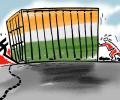
India's exports contracted by 22 per cent, the steepest decline in the last three years, to $32.97 billion in June on account of global demand slowdown, especially in the Western markets like the US and Europe. According to the data of the commerce ministry, the trade deficit in June stood at $20.3 billion against $22.07 billion in the same month last year due to a fall in exports and imports. The inbound shipments during the month under review declined by a steep 17.48 per cent to $53.10 billion.

Infosys on Thursday posted a 7.8 per cent year-on-year rise in consolidated net profit at Rs 6,128 crore in March quarter of FY23, and gave 4-7 per cent revenue growth forecast for FY24 amid macro economic uncertainities. The net profit (after minority interest) stood at Rs 5,686 crore in the fourth quarter of FY22. Seen sequentially, the net profit for Q4 came in 7 per cent lower.
Dissatisfied with the wage hike offer made by Indian Banks' Association (IBA), public sector lenders' employee unions on Monday threatened to go on a two-day strike from February 10.

The NSE Nifty also moved up by 12 points to 8,648.35.
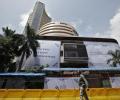
The mid-cap index fell while small-cap advanced.

'Fear is also a great impetus to push people in the right direction.' 'So, everyone who has touched black money is scared and I'm very happy about it.'

Benchmark share indices erased all the day's gains to end marginally lower on Monday as the measures announced by the government failed to meet market expectations.

Benchmark indices started the trade on a weak note on Wednesday with the Sensex falling 564.77 points, following feeble global market trends and persistent foreign capital outflows. The 30-share BSE Sensex was trading 564.77 points lower at 52,612.68. The NSE Nifty dipped 162.4 points to 15,687.80. Among the Sensex pack, IndusInd Bank, Hindustan Unilever, Bajaj Finserv, Titan, Kotak Mahindra Bank and Bajaj Finance were the major laggards in early trade.

India is among the worst-performing BRICS nations along with Brazil (ranked even lower than India at 71st this year).

The S&P BSE Sensex gained 57 points to end at 26,064 and the Nifty50 climbed 17 points.

The sharp rally in the broader markets has propelled India's market capitalisation (m-cap) to a new high. The combined m-cap of all BSE-listed firms rose to Rs 291.9 trillion in intraday trade on Thursday before settling lower at Rs 290.9 trillion. The previous record was on December 14, 2022, at Rs 291.3 trillion.

Markets ended marginally lower after trading in a narrow range, amid mixed global cues, with banks, software and capital goods shares leading the decline.

Equity indices frittered away a good start to close with modest losses on Monday, pressured by heavy selling in metal stocks after the government imposed export duties on steel-making raw materials to curb soaring prices. The 30-share BSE Sensex opened strong and gained momentum as the session progressed, but came under severe selling pressure in afternoon trade to close 37.78 points or 0.07 per cent lower at 54,288.61. On similar lines, the broader NSE Nifty slipped 51.45 points or 0.32 per cent to end at 16,214.70.
Equity benchmark Sensex declined nearly 390 points on Friday, pressured by heavy selling in IT, tech and energy stocks despite a positive trend in the global markets. Besides, rising crude oil prices and relentless foreign capital outflows further weighed on sentiment, traders said. The 30-share BSE Sensex opened strong but came under severe selling pressure to close 389.01 points or 0.62 per cent lower at 62,181.67.

Aditi Ashok has risen to 15th on the LPGA's Race to CME Globe and could well go better than career-best 48th in world rankings.

Equity indices nursed losses for the second consecutive session on Tuesday as investors continued to dump IT, banking and FMCG stocks amid a bearish trend in global markets. Unabated foreign fund outflows and the rupee dropping to another record low against the US dollar added to the woes, traders said. Participants were also in wait-and watch mode ahead of release of retail inflation and factory output data.

The Sensex ended up 380 points at 27,888 and the Nifty advanced 111 points to end five points shy of 8,400.

Missing the deadline for filing Income Tax returns can lead to consequences.

HCL Tech was the top gainer in the Sensex pack, rising around 3 per cent, followed by Tech Mahindra, Tata Steel, Wipro, NTPC and Titan. Nifty advanced 187.05 points to 16,801.25.

Ultratech Cement was the top gainer in the Sensex pack, surging nearly 3 per cent, followed by M&M, Maruti, Tata Steel, TCS, L&T, SBI and HUL. NSE Nifty advanced 52.35 points to 18,308.10.

Benchmark indices ended on a flat note on Thursday as fag-end selling wiped out intra-day gains amid weak global trends. The BSE benchmark Sensex slipped 8.03 points or 0.02 per cent to settle at 53,018.94. During the day, it had gained 350.57 points or 0.66 per cent to 53,377.54. Similarly, the broader NSE Nifty fell 18.85 points or 0.12 per cent to close at 15,780.25.

It is as much about farmer woes and the lack of job opportunities as about the mixing of religion and politics.

The rupee has depreciated 9.7 per cent against the US dollar over a year and with the RBI stemming the rupee's weakness through dollar sales, its reserves have dropped to their lowest levels since October, 2020. The fall in reserves has widespread implications.

The foreign lender's profit after tax was Rs 2,960 crore

Benchmark indices failed to hold on to early gains and closed in the red for the seventh straight session on Thursday, with participants remaining in wait-and-watch mode ahead of the RBI's interest rate decision. Unabated selling by foreign funds added to the pressure, though a modest recovery in the rupee cushioned the fall, traders said. After rallying in early trade, the 30-share BSE Sensex came under selling pressure in the afternoon session and closed 188.32 points or 0.33 per cent lower at 56,409.96.

The markets may be entering a consolidation phase and are expected to trade sideways for now after a good run in the last few weeks, suggest analysts. In this backdrop, they suggest investors can book profits at the current levels and enter the market again on a decline from a medium-to-long term perspective. Thus far in fiscal 2023-24 (FY24), the S&P BSE Sensex has moved up around 5 per cent to nearly 62,000 levels.

The United Forum of Bank Unions would be holding a one-day all-India strike on January 7 followed by a four-day strike from January 21-24.

Bucking a strong trend in share market, the Indian rupee on Monday gave up all its initial gains and slipped 18 paise to close at 61.94 against the Greenback on rising dollar demand from importers.

Market breadth depicted strength. There were almost 3 gainers against every loser on BSE

Input prices rose at their fastest rate in 14 months but manufacturers absorbed much of the increase

Equity benchmark Sensex slumped over 1,000 points to sink below the 55,000-level on Friday, tracking deep losses in IT, finance, banking and energy stocks amid widespread selling in the global markets. A weak rupee, surging crude prices and relentless foreign capital outflows further weighed on sentiment, traders said. The 30-share BSE index ended 1,016.84 points or 1.84 per cent lower at 54,303.44.

The state police has so far arrested 112 supporters of Amritpal.

IndusInd Bank was the top laggard in the Sensex pack, shedding around 3 per cent, followed by ICICI Bank, Titan, Infosys, HDFC Bank, Nestle India, Sun Pharma and Reliance Industries. The broader NSE Nifty slipped 41.20 points or 0.35 per cent to 11,896.45.

The entire operation was meant to have a chilling effect on independent journalists, those not completely subservient to the regime, the small section still doing what the Fourth Estate should do -- raising questions to those in power.
